
Pure Water & Clean Energy
Bringing Clean Water To Every Corner On Earth
Pure Water & Clean Energy
Bringing Clean Water To Every Corner On Earth
Industrial-grade ion-exchange softening with Fleck control valves to eliminate scale and protect boilers, cooling towers, laundries, and process equipment.
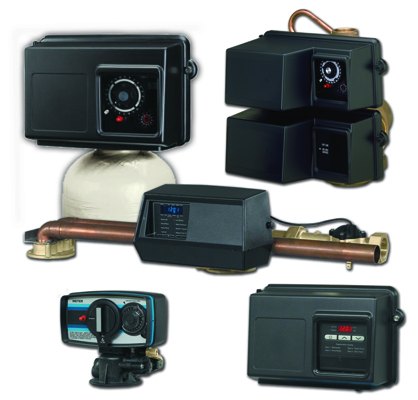
Hard water drives up energy bills, shortens equipment life, and forms scale that clogs boilers, cooling towers, water heaters, and RO membranes. ForeverPure engineers commercial and industrial water softener systems that remove calcium and magnesium hardness through ion exchange, delivering consistently soft water for facilities of any size.
Each system is built around dependable Fleck control valves and high-capacity softening resin, automated for service and regeneration, and sized to your hardness load and flow rate. Replacement resin, valves, and brine components are always available through our store at foreverpureplace.com.
ForeverPure softeners are configured to match how your facility uses water:
Pair softening with a commercial water treatment system or commercial RO system, or browse the components and Fleck valves we integrate.
Softener sizing is driven by two numbers: how many grains of hardness you must remove between regenerations, and how much flow the resin bed has to pass without channelling. Get either wrong and the system either regenerates constantly or leaks hardness at peak demand. Our commercial water softener sizing guide works the full method through with a 24,000 gallon-per-day example, including the salt-efficiency trade-off and the backwash flow check.
Daily hardness load (grains) = daily volume (gallons)
× hardness (grains per gallon)
Convert a lab result with 1 gpg = 17.1 mg/L as CaCO₃ —
so 340 mg/L hardness is roughly 20 gpg.
| Parameter | Design range | Notes |
|---|---|---|
| Exchange capacity | 20,000–30,000 grains per ft³ | 20k at 6 lb salt/ft³, 24k at 10 lb, 30k at 15 lb — higher salt buys capacity at lower efficiency |
| Continuous service flow | 6–8 gpm per ft³ | Above this, hardness leakage rises |
| Peak service flow | up to 15 gpm per ft³ | Short excursions only |
| Backwash flow | 5–7 gpm per ft² of bed area | Must fluidise the bed; check at your coldest water temperature |
| Pressure drop, clean bed | Typically under 15 psi | Rises with fouling |
| Salt efficiency | ~3,000–4,000 grains per lb of salt | Best at the low end of the salt dose |
A laundry runs 24,000 gallons per day on 20 gpg hardness. Daily load is 24,000 × 20 = 480,000 grains. At 24,000 grains/ft³ (10 lb salt/ft³) that needs 20 ft³ of resin to run a full day between regenerations. If peak draw is 50 gpm, 20 ft³ gives 2.5 gpm/ft³ — comfortably inside the continuous range, so capacity rather than flow sets the size here.
Where the plant cannot stop for regeneration, the same duty is met with a twin-alternating pair: one tank in service while the other regenerates, giving genuinely uninterrupted soft water.
Send us your hardness analysis, daily volume and peak flow and we will size the vessel, resin volume and valve, and confirm salt and backwash requirements. Softening is also the standard pretreatment ahead of RO — see the SWRO design guide and chemical dosing guide.
A commercial water softener removes hardness minerals (calcium and magnesium) by ion exchange. Hard water passes through a resin bed that swaps the hardness ions for sodium or potassium. When the resin is saturated it automatically regenerates with a brine solution. ForeverPure systems use Fleck control valves to automate service and regeneration based on flow or time.
Sizing depends on your water hardness (grains per gallon), peak flow rate, and daily water usage. The softener's grain capacity must handle the total hardness load between regenerations. Provide a water analysis and your flow requirements and ForeverPure will size a simplex, duplex, or twin-alternating system for continuous soft water.
A duplex (twin-alternating) softener uses two resin tanks so one is always in service while the other regenerates. This delivers uninterrupted soft water 24/7, which is essential for hotels, laundries, boilers, and continuous process applications where a single tank's downtime would be a problem.
Softening removes hardness to prevent scale but does not reduce total dissolved solids (TDS). Reverse osmosis removes dissolved salts and produces high-purity water. Many facilities use a softener as pretreatment ahead of RO to protect the membranes. ForeverPure can engineer softening, RO, or a combined train based on your goals.
Send us your water hardness and flow requirements. Our engineering team will size a commercial water softener system that keeps your equipment scale-free.
Request a Quote